Drills

The shortlist. Not the full YouTube rabbit hole.

Golf instruction on YouTube is enormous and mostly repetitive. We've cut it to the drills actually worth your limited range time — organised by level, so you always know what to work on next. Save the ones relevant to your game and come back to them.

19 drills, 3 levels
3 range routines
Save to your Drill Box

My Drill Box

0 saved

Bookmark drills below to build your personal practice plan — they'll stay saved in this browser.

You haven't yet built a repeatable swing. That's fine. These six drills build the fundamentals — putter face control, connected chipping motion, and a compact half-swing — so you have something consistent to build on before reaching for driver.

Putting

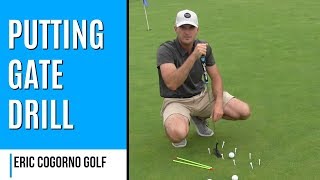
Gate Drill

Beginner2 tees

Groove a square putter face and a straight start line from short range.

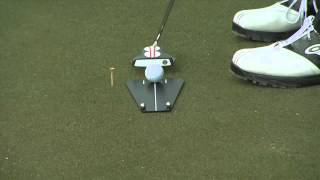
  1. Place two tees just wider than your putter head a few inches in front of the ball, forming a narrow gate.
  2. Set up to a 4–6 foot putt with little to no break.
  3. Stroke the ball through the gate without clipping either tee.
  4. Make five in a row before moving back a foot.

If the ball can't pass through a gate this narrow, it was never going in anyway.
Gate Drill
▶ WATCH THE DRILL
Putting

3-Foot Circle Drill

Beginner6–8 balls, tees

Build confidence by holing the short ones that matter most for your score.

  1. Set six to eight balls in a circle around a hole, each exactly three feet away.
  2. Hole every single one before moving to the next drill. No skipping.
  3. If you miss, start the circle over from the beginning.
  4. Once you can hole all eight consistently, move the circle to four feet.

Dave Pelz's research shows most three-putts begin by missing a short putt after a good lag. This drill fixes exactly that.

3-Foot Circle Drill
▶ WATCH THE DRILL
Chipping

Triangle / Connection Drill

BeginnerWedge, small towel

Keep your chipping motion connected so contact stays consistent.

  1. Tuck a small towel under both upper arms so it sits across your chest.
  2. Chip short shots focused on keeping the towel in place throughout.
  3. If the towel drops, your arms disconnected from your body — the most common chipping fault.
  4. Hit twenty chips trying to keep the towel in place all the way to the finish.

Most chipping misses come from the wrists or arms taking over rather than a connected shoulder rock.

Triangle Connection Drill
▶ WATCH THE DRILL
Chipping

One-Hand Chip Drill

BeginnerWedge only

Feel the correct wrist position at impact and train clean contact.

  1. Hold your wedge with your trail hand only, dropping your lead hand to your side.
  2. Chip short shots using only the trail hand — focus on keeping the wrist firm through impact.
  3. If the wrist flips, the ball flies low or thin — that's the fault this drill exposes.
  4. Do ten one-handed chips, then switch to both hands and notice the improved feel.

One-handed practice forces you to feel the correct wrist angle through impact — the thing beginners most often get wrong.

One-Hand Chip Drill
▶ WATCH THE DRILL
Full Swing

9-to-3 Half Swing Drill

BeginnerAny iron

Build a repeatable, compact swing before adding length and speed.

  1. Set up normally with a 7-iron or 8-iron, relaxed grip.
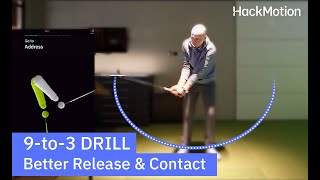
  2. Swing the club back to 9 o'clock (hands at hip height), keeping the club face neutral.
  3. Strike the ball and swing through to 3 o'clock (hands at hip height on the other side).
  4. Hit twenty balls with this half swing, focusing on contact quality — not distance.

If you can't compress the ball with a half swing, a full swing won't fix it — it'll only make it faster and messier.

9-to-3 Half Swing
▶ WATCH THE DRILL
Full Swing

Headcover-Under-Arm Drill

BeginnerHeadcover or small towel

Keep your arms connected to your body through the swing.

  1. Tuck a headcover or small towel under your trail-side arm, against your ribs.
  2. Make slow, half-speed swings without letting it drop.
  3. Build up to three-quarter swings while keeping it in place.
  4. Hit a few real shots and notice how much more centred the contact feels.

Disconnection between arms and torso is one of the most common amateur faults — this makes it obvious the instant it happens.

Headcover-Under-Arm Drill
▶ WATCH THE DRILL

You have a swing and a rough idea of what it does — now you need consistency, distance control, and fewer self-inflicted doubles. These eight drills work on the mistakes that cost intermediate golfers the most strokes.

Putting

Clock Drill

Intermediate8–12 balls

Build confidence on the short putts that actually save your score.

  1. Place balls in a circle around the hole, like a clock face, all the same distance.
  2. Start at three feet and hole every ball before moving to the next position.
  3. Miss one and restart the full circle at that distance.
  4. Complete the circle at three feet, then stretch to five, then eight.

Most three-putts come from missing the short putt after a good lag — not from the lag itself.

Clock Drill
▶ WATCH THE DRILL
Putting

Lag Putting Safe Zone Drill

IntermediateAlignment stick, 5 balls

Stop three-putting from long range by training speed first, line second.

  1. Lay a club or alignment stick two feet beyond the hole on the far side.
  2. From 25–40 feet, putt five balls trying to finish between the hole and the stick — the "safe zone".
  3. Any ball short or past the stick counts as a miss, regardless of line.
  4. Aim for at least three of five inside the safe zone before increasing the distance.

A two-putt from 40 feet beats a three-putt from 40 feet every time. Speed control is the whole skill at long range.

Lag Putting Safe Zone
▶ WATCH THE DRILL
Putting

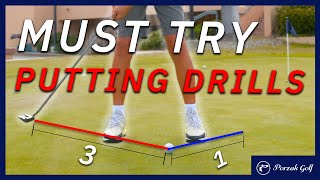
3-6-9 Ladder Drill

Intermediate3 balls, 3 tees

Train distance control across the full range of putts you face most rounds.

  1. Mark 3, 6 and 9 feet from a chosen hole with tees.
  2. Putt one ball from each distance, holing all three to complete a "ladder."
  3. Miss any putt and restart the full ladder from 3 feet.
  4. Count how many complete ladders you finish in ten minutes — beat it next session.

The pressure of restarting on a miss turns a routine practice into something that actually mirrors what you feel on the course.

3-6-9 Ladder Drill
▶ WATCH THE DRILL
Chipping

"Train Track" Alignment Drill

Intermediate2 alignment sticks

Stop chunked and bladed chips by controlling your swing path.

  1. Lay two sticks parallel, just wider than a ball's width apart, pointing at your target.
  2. Place a ball between them and chip normally.
  3. Watch whether your divot and clubhead stay inside the track without crossing either stick.
  4. Narrow the track slightly once you're consistently staying inside it.

Instant visual feedback on swing path — no guessing where the miss came from.

Train Track Alignment Drill
▶ WATCH THE DRILL
Chipping

Landing-Spot Drill

IntermediateHoop or tees, 8–10 balls

Train your eye to aim at a landing spot, not the flag — the way good chippers actually think.

  1. Place a hoop or a circle of tees on the green at different distances short of the hole.
  2. Chip toward the landing circle — not the flag — and let the roll do the rest.
  3. Vary club and trajectory to see how the landing spot needs to change for each shot.
  4. Track how many of ten balls land inside the circle.

Good chippers aim at where the ball lands, then trust the roll — not at the flag directly.

Landing-Spot Drill
▶ WATCH THE DRILL
Full Swing

Hip Bump Drill

Intermediate1 alignment stick

Fix the "stuck on the back foot" miss that causes thin, weak shots.

  1. Push an alignment stick into the ground just outside your front foot.
  2. Take your normal setup.
  3. At the start of the downswing, bump your front hip toward the stick before the club reaches the ball.
  4. Hit a dozen shots focusing only on that hip movement — not the outcome.

If your weight never moves forward, your low point of contact never moves forward either — fat and thin shots follow.

Hip Bump Drill
▶ WATCH THE DRILL
Full Swing

"Train Track" Swing Path Drill

Intermediate2 alignment sticks

Correct an outside-in swing path — the single biggest cause of a slice.

  1. Lay one stick along the ball-target line, just outside the ball.
  2. Lay a second stick parallel to it, just outside your stance — forming a narrow track.
  3. Swing so the clubhead travels inside the outer stick through impact.
  4. Hit ten balls, counting how many feel like they came from inside the track.

An over-the-top path that swings from outside the ball to inside is what creates a slicing contact every time.

Train Track Swing Path Drill
▶ WATCH THE DRILL
Bunker

Line-in-the-Sand Drill

IntermediateRake or club, bunker

Learn exactly where your club should enter the sand — the whole game in bunkers.

  1. Draw two parallel lines in the sand a hand's width apart, perpendicular to your target.
  2. Set a ball just behind the back line.
  3. Swing so the club enters the sand inside the two lines — not before and not after.
  4. Once your entry point is consistent without a ball, add one and play the real shot.

Bunker shots aren't about hitting the ball — they're about controlling exactly where the club enters the sand relative to the ball.

Line-in-the-Sand Drill
▶ WATCH THE DRILL

You're scoring consistently in the 80s or better. The gap now is precision, shot-shaping, and performing under pressure — not fundamentals. These five drills address the skills that separate consistent single-digit players from everyone else.

Full Swing

Pause at the Top Drill

ExpertAny iron

Improve transition sequencing so the lower body leads the downswing, not the arms.

  1. Swing to the top of your backswing and pause for a deliberate one-second count.
  2. During the pause, feel the lower body begin to shift toward the target before the arms move.
  3. Then swing down — letting the body lead and the arms follow.
  4. Hit fifteen balls with this exaggerated pause before transitioning to normal tempo.

Hideki Matsuyama is the most famous proponent of this — the pause trains the correct kinetic sequence that creates effortless power.

Pause at the Top Drill
▶ WATCH THE DRILL
Full Swing

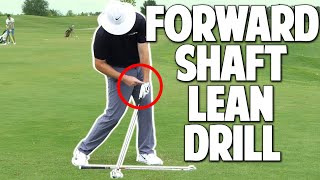
Shaft Lean / Compression Drill

ExpertShort iron, impact bag or wall

Compress the ball like a tour player — forward shaft lean at impact, hands ahead of the clubhead.

  1. Set up with a short iron and drop a tee or alignment stick one foot ahead of the ball, in line with your lead hip.
  2. Swing and make contact driving your hands through to the tee position before the face arrives.
  3. Focus on the feeling of the handle leading the clubhead through impact — not the other way around.
  4. Hit twenty balls with a short iron before moving to a longer club.

Amateurs typically let the clubhead catch the hands at impact (flipping). That destroys compression, spin, and distance. This drill builds the habit of hands-first impact.

Shaft Lean Compression Drill
▶ WATCH THE DRILL
Full Swing

Shot-Shaping Drill — Draw & Fade

ExpertMid-iron, two targets

Develop intentional control of ball flight — curving the ball on demand, not by accident.

  1. Pick two targets: one slightly left (for a draw) and one slightly right (for a fade) of your main flag.
  2. For a draw: aim your feet right of the target, close the face slightly relative to your swing path, and swing along your foot line.
  3. For a fade: aim your feet left, open the face slightly, and swing along your foot line.
  4. Alternate draw and fade on every shot, five of each, then compare results.

Understanding how face-to-path ratio determines curve transforms you from a reactive golfer into one who actually manages the course.

Shot Shaping Draw Fade
▶ WATCH THE DRILL
Short Game

Flop Shot Drill

ExpertLob wedge, tight lie or good lie

Hit a high, soft shot over an obstacle with no run — the shot that rescues par from nowhere.

  1. Open the lob wedge face significantly before taking your grip (so the face points at the sky).
  2. Open your stance to match — feet aiming left, face aiming at or right of the target.
  3. Swing along your foot line (left) at full speed, letting the open face do the work of getting it high.
  4. Practice over a bag or towel acting as an obstacle, building commitment to the full swing through the ball.

The flop shot fails when golfers decelerate out of fear. A committed, full swing with an open face is what gets the ball up — hesitation skulls it across the green.

Flop Shot Drill
▶ WATCH THE DRILL
Putting

Pressure Putting Game

Expert8–10 balls, scorecard

Simulate the pressure of a short putt that matters — so you're not practicing in conditions that don't exist on the course.

  1. Set eight balls at four different distances (two balls each at 3ft, 5ft, 8ft, 12ft).
  2. Your goal: hole all eight in succession without a miss. Keep score honestly.
  3. If you miss, note the distance, restart that distance pair, but continue counting your overall score.
  4. Play three "rounds" (24 putts total) and track your score across sessions over weeks.

Mindless repetition doesn't transfer to on-course performance. Adding consequences and a score trains the mental process of putting under pressure — not just the mechanics.

Pressure Putting Game
▶ WATCH THE DRILL

Most golfers go to the range, tip a bucket out, and start hitting driver. That's not practice — it's cardio. These two routines structure your balls into a session that actually carries over to the course. Pick 50 or 100 depending on how much time you have.

Range Routine · 50 balls

50-Ball Structured Session

45–60 minutes. The minimum effective session if you want to actually improve — not just exhaust a bucket.

50-ball range routine
▶ WATCH
10BALLS

Phase 1 — Wedge warm-up

Start with your pitching wedge or gap wedge at half speed. These aren't practice shots — they're for waking your body up. Focus on rhythm, not distance. Hit to a target around 80 yards. This is not where the session starts; it's where the body starts.

15BALLS

Phase 2 — Mid-iron drill work

Pick ONE drill from the Beginner or Intermediate section and hit these fifteen balls doing that drill exclusively. Pick a target, commit to it on every shot, and walk behind the ball between each one to reset your pre-shot routine. This is the most important phase.

10BALLS

Phase 3 — Long irons or fairway wood

Five balls with a 5-iron or 4-iron, five with a fairway wood. You're just confirming the same feeling carries into longer clubs — not changing anything. If it falls apart, go back to Phase 2 with the same drill and longer club.

5BALLS

Phase 4 — Driver

Five driver shots, all to the same target, with your full pre-shot routine. One per minute. If driver is your main issue today, swap Phase 3 and 4 so you have more balls here — but don't skip Phase 2.

10BALLS

Phase 5 — Back to scoring clubs

Return to wedge and short-iron shots from 50–100 yards — the distances you'll face on almost every hole. Pick a specific target and try to land within a towel-sized zone. These shots lower your handicap faster than driver practice.

50

balls. Every one with a target, every one with a purpose. If you can't name the intention before you hit it, don't hit it yet.

NCR range tip: Get to the range early or book a bay ahead. Popular ranges like Zen Golf and Qutab fill up fast in cooler months, especially on weekends between October and March.

Range Routine · 100 balls

100-Ball Deep Practice Session

90–120 minutes. For when you have real time to work on something and want it to stick.

100-ball range session
▶ WATCH
15BALLS

Phase 1 — Extended warm-up with wedges

Wedge at 50%, 75%, then full. Take your time here — the quality of the next 85 balls depends on how good your rhythm is by the end of this phase. Alternate wedge distances. Five balls at 50 yards, five at 80, five at 100.

25BALLS

Phase 2 — Drill focus block

Choose one drill from your level and do nothing else for 25 balls. This is the core of the session. If you're an intermediate player working on the hip bump, every single one of these 25 balls is a hip bump drill. Set up a physical cue (the alignment stick, the tee, the headcover) every time.

20BALLS

Phase 3 — Club progression

Take the same intention from Phase 2 and move through clubs: five mid-iron, five 5-iron, five fairway wood, five driver. You're testing whether the drill feeling transfers up the bag — most of the time it does.

20BALLS

Phase 4 — Shot simulation game

Play an imaginary hole with every shot. Ball 1: tee shot to a specific target. Ball 2: approach from 150 yards to a target flag. Ball 3: wedge in from 80 yards. Ball 4: another hole. This turns range practice into golf — which is the only thing that actually transfers.

20BALLS

Phase 5 — Scoring zone intensive

Pure wedge and short iron work from 50–120 yards. Land five in a row within a target zone before moving to the next distance. This phase has the highest ROI of anything you'll do at the range — more short game finesse means fewer doubles on the card.

100

balls. The 25-ball drill block and the simulation game are the two phases most golfers skip. They're also the only phases that actually transfer to the course.

Important: take a one-minute break between phases. Walk around, shake out your hands, look at the landscape. Physical rest resets mental focus — and mental fatigue is why the last 20 balls of a bucket are always worse than the first 20.

You've got 15–20 minutes and 20 balls before the round. Don't use them to "find your swing" or work on anything. Use them to confirm your rhythm, find your tempo, and get to the first tee having already hit a few real shots.

Pre-Round · 20–25 balls + putting green

Pre-Round Warm-Up Sequence

15–20 minutes range time. Build toward the first shot of the round, not away from it.

Pre-Round Warm-Up
▶ WATCH
5BALLS

Wedge — find your rhythm

Half-speed wedge shots to a target about 50 yards away. You're not warming up your muscles here — you're finding the pace of today's swing. Every golfer feels slightly different each day. These five balls tell you what you're working with.

5BALLS

7-iron or 8-iron — your most reliable club

Full speed, pick a specific target, include your pre-shot routine. This is your "trust" club — the one you know. By the end of these five, you should have some feel for whether today is a good ball-striking day or a course-management day.

3BALLS

Fairway wood or hybrid

Three shots to a target. If they feel good, great. If they don't, don't chase them — make a note and factor it into your course management today. You're not fixing anything now.

3BALLS

Driver

Three shots. If the first hole is a tight par-4, hit all three to a tight target. If it's a wide opener, three normal shots. The goal is confidence, not distance.

4BALLS

Back to wedge — the last thing before the first tee

Finish on wedges, not driver. Leave the range with the feel of a short, clean, confident swing — not a big swing you can't repeat. You want your last range feel to match the first shot you're likely to face approaching a green.

20

balls on the range. Then spend equal time on the practice putting green — lag-putting first to get distance feel, then a handful of three to five-footers to build confidence before you walk to the first tee.

The rule for pre-round warm-ups: Never work on a swing thought you haven't already drilled. Pre-round is for confirming what you have today — not for discovering something new that you'll think about on the first tee. If you're thinking mechanically on hole one, you warmed up wrong.

New — AI Swing Analysis

Record your swing. Get instant feedback.

Create a free account, record from behind and from the side, and get AI coaching on your specific drill in seconds.

Try AI Swing Analysis →

Practice alone gets boring

Bring someone with you next time.

Find a range partner or a weekend game through the community board.

Find your four